Goose Walking on Grass Redwork Design
Pulling a new embroidery file out of the folder and loading it into the machine always gives me a moment of anticipation. Will it stitch cleanly? Will the scale feel right on a finished product? Will a customer actually want to wear it or give it as a gift? When I first opened Goose Walking on Grass Redwork Design, I was curious how a redwork motif this simple would hold up under real production conditions. After several test runs on different fabric types and product blanks, I have a clear picture of what this design delivers and where it fits best in a craft business or personal project lineup.
First Impressions: A Design That Knows Its Place
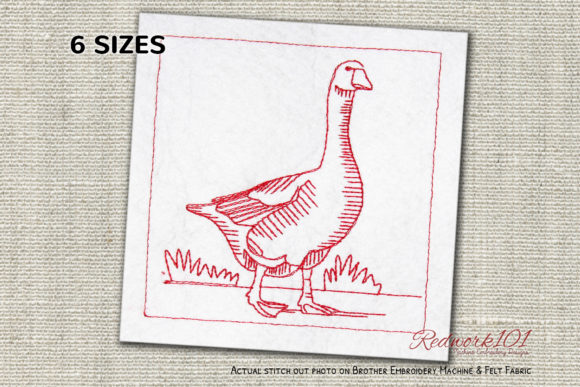
The visual mood of Goose Walking on Grass Redwork Design is quiet, cheerful, and unfussy. It does not try to be a photo-realistic bird portrait or a dense, layered composition. Instead, it leans into the charm of a single line-art goose stepping across a small patch of grass, rendered in classic redwork style. The shape is clean and recognizable without being overly detailed. The goose has a gentle, slightly rounded silhouette that feels friendly rather than stiff. The grass beneath its feet is simple and sparse, which keeps the whole piece from looking crowded.
That sense of openness is one of the design's strongest assets. It leaves room for the fabric to breathe and for the stitching to stand out clearly. In the world of embroidery, especially for Birds motifs, there is a tendency to overcomplicate things with too many stitch types or tiny fill areas. This design avoids that trap. It feels like a piece that was drawn with a steady hand and a clear idea of what it wanted to be.
The redwork approach also gives it a slightly vintage, homey feel. It reminds me of heirloom linens or simple kitchen textiles that have been passed down, but the subject matter is current enough to appeal to modern tastes. That balance is hard to achieve, and Goose Walking on Grass Redwork Design manages it naturally.
Real-Life Stitching Performance Across Products
I tested Goose Walking on Grass Redwork Design on a few different product blanks to see how it behaved in real stitching conditions. The first run was on a midweight canvas tote bag. The fabric had a bit of texture, and I was curious whether the fine lines of the goose and grass would get lost. To my relief, the design held its shape beautifully. The running stitches and satin stitch elements stayed crisp, and the goose's outline read clearly from a few feet away. The tote bag ended up looking like a boutique piece rather than a simple DIY project.
Next, I stitched it onto a cotton sweatshirt. This is a product category where a lot of embroidery designs fail because the fabric has some stretch and the stitches can pull or distort. The Goose Walking on Grass Redwork Design handled it well. Because the stitch density is moderate and the design does not rely on heavy fill stitching, the fabric did not pucker or ripple around the motif. The design sat flat and looked clean after washing. That is a big win for anyone producing custom apparel for clients or for an Etsy seller who cannot afford returns due to stitching issues.
I also tested it on a flour sack towel for a kitchen product idea. The thin, loosely woven fabric can be a challenge for dense designs, but the open nature of this redwork motif meant the towel did not bunch up or show hole distortion. The stitching looked almost like a hand-drawn illustration, which is exactly the kind of handmade product feel that buyers respond to. For a small shop product or a holiday embroidery project, this design fits naturally.
One more test worth mentioning: a baby onesie. The fabric was soft and lightweight, and the design size was appropriate for the small garment. The Goose Walking on Grass Redwork Design did not overwhelm the onesie, nor did it look too tiny. It landed in that sweet spot where a personalized gift feels intentional and not just slapped on. The redwork color gave it a soft, classic look that works for both boys and girls.
Where This Design Shines Brightest
After running these tests, I have a strong sense of the products that will make Goose Walking on Grass Redwork Design look its best. The list is broader than you might expect for a simple redwork piece.
- Tote bags and market bags – The single-color, clean-line style looks fresh against natural canvas or linen. It adds value without making the bag feel heavy.
- Sweatshirts and t-shirts – The design works well on casual apparel. It does not fight the fabric texture, and it gives the garment a relaxed, artistic feel.
- Kitchen linens and tea towels – This is a natural home for a goose motif. The redwork style fits the kitchen aesthetic, and the design withstands washing well.
- Baby apparel and nursery decor – The gentle personality of the goose makes it a good choice for baby gifts. A small embroidered patch on a bib or a onesie feels thoughtful.
- Pillow covers and blankets – The design can be centered on a throw pillow or placed in a corner of a baby blanket. It adds a focal point without dominating the piece.
- Embroidered patches – Because the design is not overly dense, it works well as a patch that can be sewn onto bags, jackets, or hats. The redwork style gives the patch a collectible, artisan look.
- Boutique product lines – For an Etsy seller or small business owner looking to build a cohesive collection, this design can be repeated across multiple product types and still feel fresh.
The design also lends itself well to printable mockups and design assets for digital product sellers. The simple silhouette is easy to photograph and present in listing photos. Buyers can immediately picture the finished item.
Where to Approach with Caution
No design is perfect for every surface, and Goose Walking on Grass Redwork Design has a few limitations that are worth knowing before you commit to a large production run.
- Very small hoop sizes – If you are working with a mini hoop or a tiny garment, the detail in the grass and the goose's legs may become too fine. Always check the design dimensions against your hoop and fabric. Test on scrap fabric before stitching the final product.
- Dark fabric backgrounds – Redwork by nature relies on a single thread color, typically red. On dark fabric, the contrast may be low. If you plan to stitch on black or navy, consider using a lighter thread color or a white bobbin case to keep the design visible. The thread color choice matters a lot here.
- Heavily textured fabrics – Fabrics like thick fleece, chenille, or high-pile minky can swallow fine running stitches. The grass blades and the goose's legs may lose definition. Stick to smoother fabrics for the best results.
- Curved surfaces like caps – The design is not inherently curved, so placing it on a cap or a curved surface may require some repositioning or a smaller hoop. The design may also need to be scaled down to fit the cap front properly.
- Stretchy or knit fabrics without proper stabilizer – The design is not overly dense, but stretchy fabric still needs a good stabilizer to prevent distortion. Use a cutaway stabilizer for knits and a tearaway for wovens. Test the combination before stitching a client order.
The Box Stitch shown in the picture is optional. The outer box color is different in most designs unless it is part of the design itself. You can skip the box entirely if you prefer a cleaner look. I personally prefer the design without the box because it gives the goose more breathing room, but the box can add a finished, framed feel for certain products like wall art or pillow covers. Decide based on the product you are making.
If you are producing commercial embroidery items for sale, make sure you check the stitch density and file format compatibility with your machine. The design should work with standard formats, but always confirm before you start a production run.
Practical Designer Notes Before You Stitch
Here are some notes I gathered from my test runs that will save you time and thread.
- Test on scrap fabric first – This is the most important step. Stitch the design on a piece of fabric similar to your final product. Check the tension, the thread color, and the overall appearance. Adjust the stitch density if needed, but the design is already well-balanced.
- Check thread color contrast – Redwork traditionally uses a deep red thread, but you can experiment with other colors. A dark teal or a warm brown could give the design a different mood. Test the contrast against your fabric color before committing.
- Review the hoop size – The design fits comfortably in a medium hoop. If you are using a small hoop, make sure the design does not exceed the hoop's stitching area. You do not want to discover a hoop jump mid-project.
- Inspect small details – The goose's legs and the grass blades are the most delicate parts. If the fabric is too thick or the stabilizer is too light, these details may lose clarity. Use a sharp needle and a quality thread.
- Test in black and white mockups – Before you stitch, view the design in grayscale or black and white. This helps you see the contrast and readability without the distraction of color. If it looks good in monochrome, it will likely look good in redwork.
- Compare light and dark fabric backgrounds – Stitch the design on both a light and a dark fabric sample. Decide which contrast works best for your target customer. Light fabric with red thread is the classic look, but dark fabric with a lighter thread color can be striking.
- Use proper stabilizer – For most fabrics, a medium-weight cutaway stabilizer is a safe choice. For lightweight fabrics, use a lightweight tearaway. For stretchy fabrics, use a cutaway with a light adhesive spray. Do not skip this step.
- Confirm licensing before selling – If you are a digital product seller or a craft business owner, check the license terms for the embroidery file. Some designs allow commercial use, others require a separate license. Make sure you have the right to sell finished products or digital files before you list anything on your Etsy shop or small shop.
The design is suitable for both personal and commercial projects, but verifying the license terms is always the responsible move. It protects your business and your reputation.
The Bottom Line for Your Craft Business
Goose Walking on Grass Redwork Design is a reliable, versatile piece of machine embroidery design work that fits a wide range of products without requiring a lot of technical adjustments. It is not a showpiece that tries to do everything at once. It is a focused, well-drawn motif that knows its strengths and stays within them. That kind of discipline is rare in the embroidery market, and it is exactly what makes this design useful for real projects.
For an Etsy seller looking to add a new applique design or a simple redwork piece to their design assets, this is a solid addition. For a small business owner producing custom apparel or handmade product lines, it offers a clean, professional look that customers will appreciate. The finished product feels thoughtful and complete, which is the ultimate goal of any embroidery project.
I would recommend Goose Walking on Grass Redwork Design to anyone who needs a reliable, attractive, and easy-to-use embroidery file that works across multiple product categories. It is a design that earns its place in your digital library and in your customers' hands.